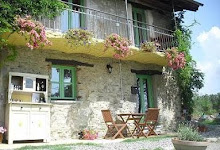
Now summer is over and guests are gone, I take the time to familiarize myself with new things, like twitter. Joined today and not sure if it's something interesting or just a waste of time. We'll see, I'm a bit of a computernerd so love to find new internet-things to do.
If you want to follow me on twitter: http://twitter.com/AgriVerdita
We also have a group on Facebook: http://www.facebook.com/search/?q=agriturismo+verdita&init=quick#/group.php?gid=66232584198&ref=search&sid=1347408835.1456215010..1
Thanks to Facebook I have more contact with people in Belgium (where I come from) than when I lived there. Strange, isn't it?
Something completely different: tomorrow we start planting our lavender, then we will really be a lavenderfarm. Very excited about this !
Wednesday, October 14, 2009

Sunday, October 11, 2009
Mushrooms
At the moment there's an obsession for mushroom-hunting here in the village. The woods are ful of the most delicious porcini and other mushrooms that I don't know the name of, but they sure taste good !
Of course we have done our part of searching. The first times we walked miles and miles without seeing or recognising anything. After a while I think the people here got a little tired of seeing us like this and one day we got visit from someone who wanted to show me which mushrooms are edible. And since then I fill my basket with the most delicious species.
Of course after the walk I have to prepare them. This means we eate a lot of them during the last days and I have a full freezer.
Really love this ! Walking around, collecting food and preparing the most wonderful dishes with it.
Of course we have done our part of searching. The first times we walked miles and miles without seeing or recognising anything. After a while I think the people here got a little tired of seeing us like this and one day we got visit from someone who wanted to show me which mushrooms are edible. And since then I fill my basket with the most delicious species.
Of course after the walk I have to prepare them. This means we eate a lot of them during the last days and I have a full freezer.
Really love this ! Walking around, collecting food and preparing the most wonderful dishes with it.


Monday, September 14, 2009
Interesting articles
Surfing around on the web I found some interesting articles about places you can easily visit while staying at Agriturismo Verdita:
Alba & Asti in 48 hours: http://www.italia-magazine.com/alba-and-asti-in-48-hours
Both cities are ca. 1 hour from our place.
Genova in 48 hours: http://www.italia-magazine.com/holidays/liguria/genova-in-48-hours
Genova is about 1 hour and 15 minutes from our agriturismo.
Alba & Asti in 48 hours: http://www.italia-magazine.com/alba-and-asti-in-48-hours
Both cities are ca. 1 hour from our place.
Genova in 48 hours: http://www.italia-magazine.com/holidays/liguria/genova-in-48-hours
Genova is about 1 hour and 15 minutes from our agriturismo.
Friday, September 11, 2009
Truffle Fairs in the Province of Asti (Piedmont) 2009
National Truffle Fairs
18 and 25 october in Moncalvo
8 november in Montiglio Monferrato
Regional Truffle Fairs
4 and 11 october in Montiglio Monferrato
8 november in Canelli
14 and 15 november in Asti
18 and 25 october in Moncalvo
8 november in Montiglio Monferrato
Regional Truffle Fairs
4 and 11 october in Montiglio Monferrato
8 november in Canelli
14 and 15 november in Asti


Monday, September 7, 2009
Guardian article
A Guardian article about walking holidays in autumn that also mentions Piemonte as interesting destination: http://www.guardian.co.uk/travel/2009/sep/05/walking-holidays-autumn
The hills of Italy's Piedmont region are thankfully on the gentle, rolling side
- conquerable for even the wooziest of ramblers, who have over-indulged on
the area's delicious barolo and barbera wines.
Friday, August 14, 2009
Fun begins !
Now the renovation works are done and guests are enjoying the apartments and our lovely region, we realise that this was why we chose this work: making people happy, is sooo much fun !
Some pictures of our agriturismo :


Some pictures of our agriturismo :


Tuesday, May 19, 2009
Walking through the Calanche
Every now and then our little village organises excursions through the surrounding Calanche, a protected nature phenomen, these are grey and naked hills that look like slate.
Some pictures of the last time :


Some pictures of the last time :


Tuesday, May 5, 2009
Restoration works
Since october we're renovating our old farm house to make it a little holiday paradise and that's a real adventure for us, people with two left hands. Luckily we have a good building team who is helping us out and day by day we see the transformation. Hopefully we're ready by the end of june to welcome our first guests !
Some before and after pictures of studio La Ginestra:
Before
After:
Some before and after pictures of studio La Ginestra:
Before


After:


Our website: http://www.verdita.com/indexeng.html
Monday, April 20, 2009
Wine Grape landscapes: Langhe, Roero, Monferrato and Valtellina
Description
In Italy, wine grape growing is in itself a highly significant cultural value in that it is widespread since Roman times and the produce has long been appreciated the world over. It is also an accurate indicator of Man's ingenuity in modelling the land to serve this purpose and in the never-ending strive to achieve high quality wines which are in great demand in several foreign countries. Indeed, Italian immigrants played a major role in introducing wine grape growing and wine production to the United States and to Australia.
Implementation of the vineyards, wine grape growing and grape-processing are the main elements that, in the course of centuries, have irreversibly bound Man's activity to the territory leaving enduring, characteristic, marks on the landscape. In these areas, where the soil is not sufficiently fertile for agriculture and the land is fractioned in small fields, wine grape growing wrote history and determined the distribution of human settlements. So much so, that the present landscape is the result of centuries of historically documented experiments and activities, with data going back to the Middle Ages when master stone-cutters from Como and Benedictine monks favoured the diffusion in these two areas of the much appreciated wine grape variety, Nebbiolo.
In Italy, wine grape growing is in itself a highly significant cultural value in that it is widespread since Roman times and the produce has long been appreciated the world over. It is also an accurate indicator of Man's ingenuity in modelling the land to serve this purpose and in the never-ending strive to achieve high quality wines which are in great demand in several foreign countries. Indeed, Italian immigrants played a major role in introducing wine grape growing and wine production to the United States and to Australia.
Implementation of the vineyards, wine grape growing and grape-processing are the main elements that, in the course of centuries, have irreversibly bound Man's activity to the territory leaving enduring, characteristic, marks on the landscape. In these areas, where the soil is not sufficiently fertile for agriculture and the land is fractioned in small fields, wine grape growing wrote history and determined the distribution of human settlements. So much so, that the present landscape is the result of centuries of historically documented experiments and activities, with data going back to the Middle Ages when master stone-cutters from Como and Benedictine monks favoured the diffusion in these two areas of the much appreciated wine grape variety, Nebbiolo.
The areas of Langhe, Roero and Monferrato form a spectacular expanse of rolling hills on prevalently Tertiary sandstone, with sandy, acid soil. Here, the various combinations of climate, cultivation techniques, type of graft and grape variety determined the development of a wide range of natural ecosystems. The landscape is marked by a succession of vineyards, where the lines of wine grapes are arranged differently according to the type of contour ploughing, (ritocchino, cavalcapoggio, girapoggio) but there are also some vineyards with a more ancient structure, known as impianti a sostegno vivo, where the grape vines are kept high and left to grow around the trunks of elms, mulberry trees, maple trees and poplars. The grapes are processed following long-standing traditional methods to produce table grapes, particularly strong wines used for improving lighter wines, dessert wines, aged wines, sparkling wines and spirits.
The vineyard's architecture, within the framework of each landscape, is also closely related to wine production, distribution and export systems; each farmhouse with its outbuildings for grape processing and, most importantly, with its wine cellars and vaults cut in the rock, where the wine is aged and stored, is typical of the area. Distribution, layout and shape of these structures are rooted in custom and particularly interesting since they are the outcome of long-lasting research and experience.
Valtellina's geomorphology, climate and orientation are particularly indicated for viticulture. With unrelenting patience the inhabitants terraced the land, managed to overcome the drawbacks of this sandy, silty, very permeable and arid soil, and to exploit the area's distinctly favourable orientation for wine grape growing thus achieving the production of high quality wines. The terracing system with dry walls used in Valtellina is commonly used for agriculture in mountain areas and in the Pre-Alp; the outstanding feature here is the extension of these terraces (nearly 2,500 kilometres distributed over 30 kilometres of mountain slopes) and the fact that they represent the result of an experimental activity that has been carried out for centuries, in particular between the second half of the 16th century and the 18th century, when the area was part of the Swiss Canton Grisons. The wine grape landscapes of Langhe, Roero, Monferrato and Valtellina have also been extensively celebrated in the arts and in literature. Modelling of the land through laborious cultivation techniques, followed by the rewarding moments - harvesting, grape processing and bottling of the wines - have created a vast heritage of age-old traditions and legends associated also to devotional phenomena. Lastly, these wine grape landscapes are the result of long research and experience reported in several scientific treatises.
Justification for Outstanding Universal Value
Satements of authenticity and/or integrity
Regional planning programmes and land utilisation charts establish that land in the proposed sites may be destined solely to viticulture, while the Chambers of Commerce of Asti, Alessandria, Cuneo and Sondrio are responsible for the site identification required, according to national legislation, for the registered declaration of origin (DOC) of the wines produced in these areas.
Valtellina's terraced cultivation comes under the protection of national legislation on cultural heritage, (Codice per i beni culturali ed il paesaggio); it is impossible here to use the usual agricultural machines so that the traditional cultivation techniques are still in use today.
Comparison with other similar properties
The comparison that immediately comes to mind is that with the areas of Tokaij production in Hungary and the Higher Douro Valley in Portugal and, in Italy, the extraordinary terraced slopes on the coastline of the Cinque Terre in Liguria.
However, the unending succession of terraced hills of Langhe, Roero, Monferrato and Valtellina, have greater spectacular value and their extension is certainly unique.
http://whc.unesco.org/en/tentativelists/5001/
Subscribe to:
Posts (Atom)